
We’re asked this time and time again…
“Does the translation also have an apostille?” This is surprising, since, as a translation agency, we cannot issue apostilles—that is the responsibility of regional councils, courts, and government agencies. Since there is a lot of confusion surrounding the topic of apostilles, we’d like to shed some light on the matter with a few facts …
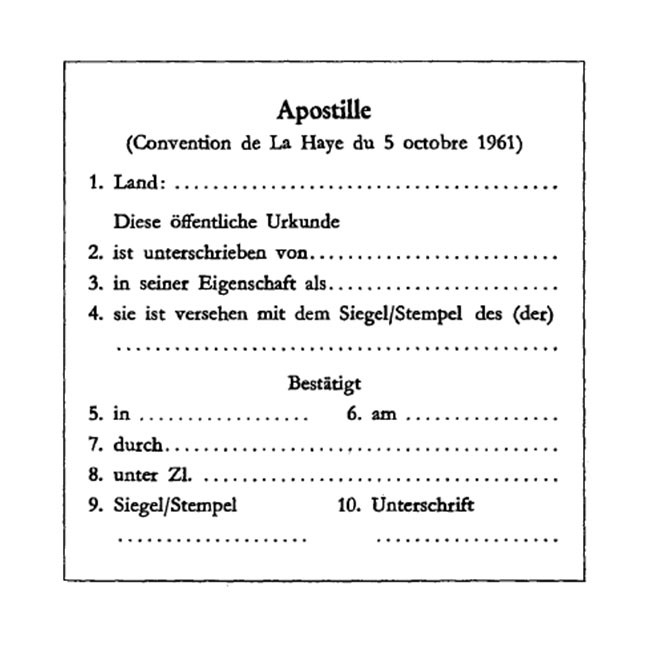
What exactly is an apostille?
In the field of certified translations, a distinction is made between two types of apostilles:
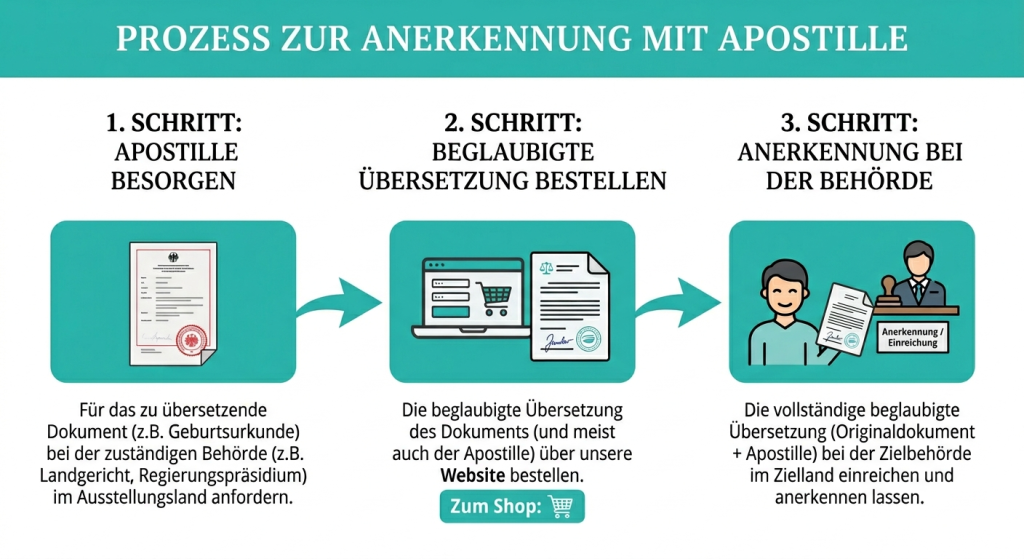
- The apostille on the document to be translated (also known as a Hague Apostille) certifies the authenticity of the document (specifically, the stamp and the official capacity of the issuer, such as a registrar). Such an apostille can then simply be officially translated along with the document, for example, into German (you can order a certified translation of an apostille here).
- The apostille on a certified translation is also known as “supplementary attestation ” or “pre-authentication”—it is affixed to the certified translation by the regional court where the translator is sworn in (we can submit the application for supplementary attestation on your behalf). This type of apostille certifies that the translator is sworn in at the respective regional court and verifies the authenticity of their signature. Some regional courts or competent authorities (e.g., the Hanover Police Department) require pre-certified/apostilled documents as the source documents for the certified translation for supplementary attestation, which is something that must be taken into account in urgent cases. In Germany, consulates often require the supplementary attestation of certified translations.
Do I need a Hague Apostille for my document, or not?
Unfortunately, it is not always clear whether a document or translation must be apostilled or further certified, as this depends not only on the legal situation but also, regrettably, on the discretion of officials or authorities. As a general rule, apostilles are required for documents from third countries (e.g., the U.S., Turkey, Ukraine) that are parties to the Hague Convention. Although the requirement for an apostille has been abolished within the EU (EU Regulation 2016/1191) and an apostille should therefore no longer be necessary, Spanish authorities, for example, often still require apostilled documents (e.g., for inheritance matters) and thus a certified translation of the apostille. The best way to find out the exact requirements for submitting your documents (e.g., with or without an apostille) is to contact the relevant destination authority—apostilles are usually required for recognition in third countries or when submitting documents from third countries in Germany.
Where can I get an apostille?
You can obtain apostilles for civil status documents (birth certificates, marriage certificates, etc.) from the relevant regional council. Apostilles for court judgments or orders (e.g., a divorce decree) or business documents (e.g., an extract from the commercial register) can be obtained from the respective courts.

Eva Bartilucci
Eva Bartilucci is a senior graduate translator. Since completing her studies in translation, linguistics, and cultural studies at Johannes Gutenberg University, she has been working as a translator and editor. She is a sworn translator for Italian and French at the Higher Regional Court of Hamm and the Regional Court of Stuttgart.
Sources: